Kenya’s gambling reforms have run into roadblock less than three weeks after the licensing regulations came into effect. The nation’s High Court has paused their implementation, leaving operators and the Gambling Regulatory Authority waiting.
Kenya’s gambling licensing framework is already facing legal pushback, yet it barely had time to settle in. On July 20, Justice William Musyoka issued an interim stay stopping the Gambling Regulatory Authority (GRA) from implementing the Gambling Control (Licensing) Regulations 2026.
The first licensing cycle had opened on July 3 but has now been put on hold following the current legal woes. Notably, Kenya’s High Court hasn’t thrown out the regulations. At least, not yet. But then, until the case is heard, the GRA cannot use the new framework to process applications or enforce the fees and compliance requirements.
Musalia Mudavadi, Kenya’s Prime Cabinet Secretary signed the regulations on June 29. They were published the next day and took effect on July 3 under the Gambling Control Act 2025. This new Act replaced legislation that dates back to 1966 and transferred regulatory duties from the Betting Control and Licensing Board to the GRA.
A little over 2 weeks later, Lawyers Thomas Buckley Opar Owuor and Ken Brance filed the challenge. Mudavadi, the GRA and the Attorney General are respondents, while the Association of Gaming Operators Kenya and Safaricom are interested parties.
That said, it doesn't mean that the Gambling Control Act itself has been suspended. Instead, the measures required to operate its licensing provisions are the problem here. So, the GRA remains in office, but its licensing process is effectively frozen.
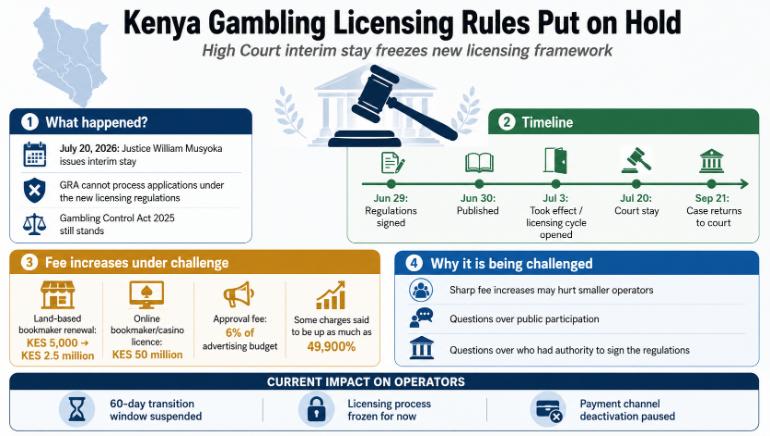
At the heart of the challenge is money, and plenty of it for that matter. For starters, the renewal fee for a land-based bookmaker has jumped from a mere KES5,000 (USD 38.60) to a whopping KES2.5 million (USD 19,298). Meanwhile, online bookmakers and casinos are now required to part with KES50 million (USD 385,950) for their licenses. On top of that, there's also an approval fee equivalent to 6% of an operator’s advertising budget.
Compared to the previous gambling regulatory regime, Owuor and Brance point out that some charges have increased by as much as 49,900%. The co-plaintiffs thus warn that smaller operators could end up closing shop, which puts tons of jobs and hefty investments at risk.
Money, however, is only half of the argument. The applicants say some final fees and capital requirements were not properly presented during public participation. That could be a problem under Article 10 of the Constitution, which recognizes public participation as a national governance principle.
The duo also questions whether Mudavadi had the authority to sign the regulations. According to their case, that power belongs to the Cabinet Secretary responsible for gaming, and not the Prime Cabinet Secretary.
For now, everyone waits. McKay Advocates expects the GRA’s 60-day transitional application window to remain suspended. The order also prevents the regulator from asking Safaricom and Airtel to deactivate payment channels belonging to operators considered non-compliant.
Despite the legal challenges, the Gambling Control Act still applies. What’s missing is a workable route for securing licences and meeting the new requirements. The applicants have 14 days to file their judicial review motion. The other parties will get 14 days to reply, and the matter returns to court on September 21, 2026.


 Slots
Slots Video Poker
 Poker
Poker Blackjack
 Roulette
 Baccarat